
Life on the Outside Ain’t What It Used To Be
There was a point when things had become so ugly, so irreversible, so convoluted, and so acutely painful to fight, that after exhausting all the options I had at the time, I was presented with a very simple choice:
- Continue to fight against serious mental illness every single moment of every single day — likely drawing from myself more pain than joy in the process — until my natural life ends.
- Take my life, and no longer face torture at the hands of an incurable disease, no longer burdening the Earth with my weight.
One might think this is a simple choice for the average person — “obviously choose to fight,” right? Not always. Sometimes you’re so far gone that you’re unable to accept reality as narrated to you by others. Whatever deathly or psychotic urge you may have feels like the truth, and though to outsiders you appear mad, to yourself, you are the locus of reason and logic.

Like a Deer in The Headlights
We’re all familiar with the “deer in the headlights” expression. The deer is flash-banged by the headlights of an oncoming vehicle, stunning the deer, who is unable to move. Should the animal remain rooted in that spot, it will certainly find itself rolling off the front-hood of life’s proverbial car, blinking its last thoughts into the cold nothing. In this expression, the deer almost never lives.
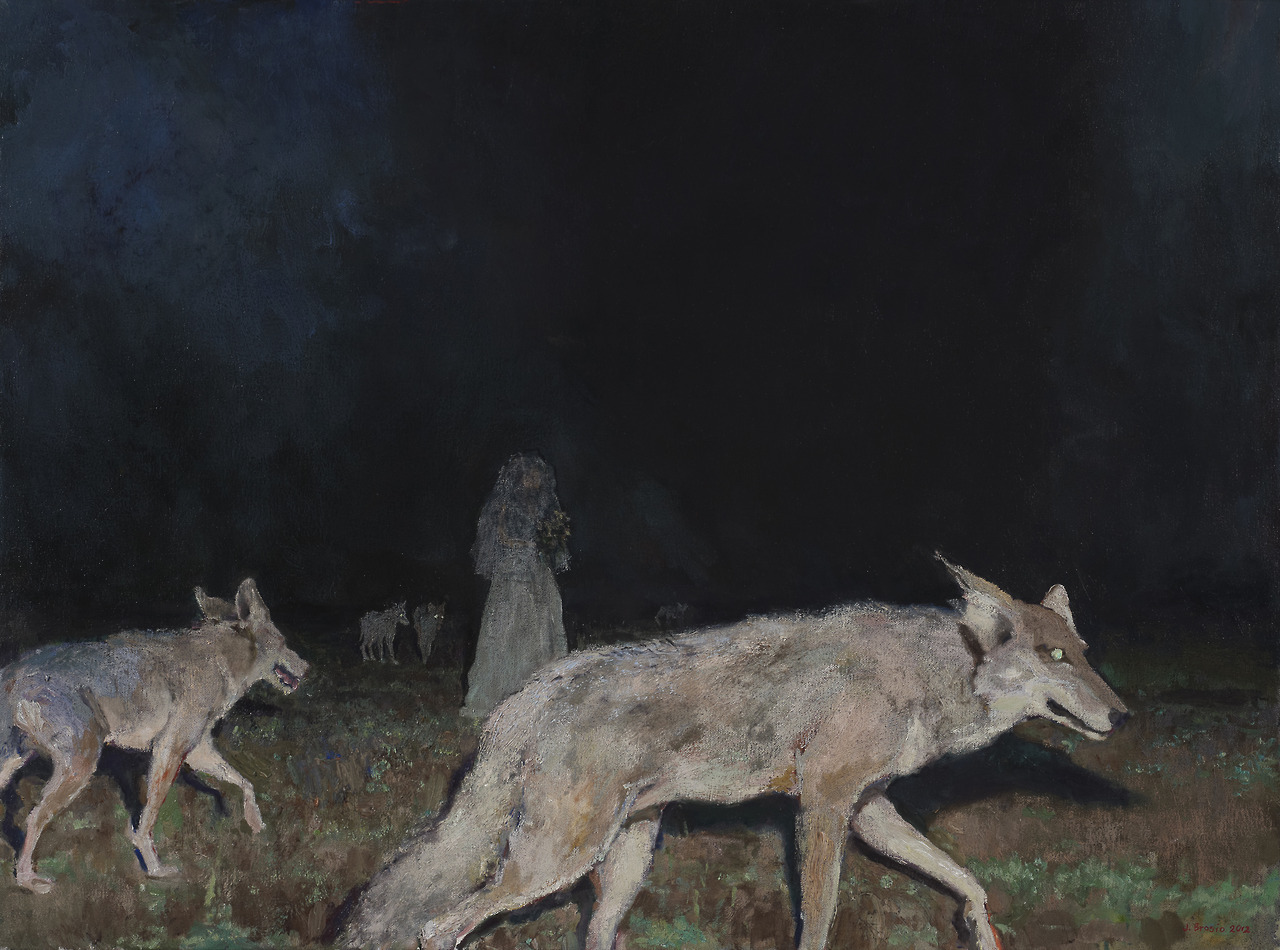
When I was twenty-two-years-old, I found myself on that hyperbolic, rain-slick road — a thirty-foot-wide asphalt python that carved through the dusky forest. With my arms wide, as if waiting for a hug, I squinted into the headlights of oncoming traffic, my outcome as unavoidable as the comet that leveled the dinosaurs.
Absurdity and Suicide
In his landmark philosophical essay, The Myth of Sisyphus, late French existentialist Albert Camus writes:
“There is but one truly serious philosophical problem, and that is suicide. Judging whether life is or is not worth living amounts to answering the fundamental question of philosophy.”
Albert Camus, The Myth of Sisyphus, page one
Camus was a French existentialist philosopher, journalist, and Nobel prize laureate, who tragically died in a car crash in 1960. The bulk of his transformative work (The Myth of Sisyphus, The Stranger, The Fall) he wrote while dodging German gunfire and artillery during the second world war.
At twenty-two, I had no great war to fight; no enemy to subjugate and conquer, save for my own soul. If I could ever even approach the subject of tolerating myself, victory would not incur flags waving over the Reichstag after brutal and de-humanizing combat. Tasked by my own disease with answering the “fundamental question of philosophy,” I searched the dim hollows of my drugged-up, manic brain, and decided that Camus was overthinking it:
“Worthless and diseased people like me don’t need to be alive.”
I reasoned that choosing to carry on guaranteed a lifetime of suffering and failed treatment. Surely, I would not lead a good life while carrying such weight. The late author David Foster Wallace — a man I deeply admire for his literary prowess — encapsulated the feeling of living with oneself as an act of revolt.
“The mind is an excellent servant but a terrible master. It is not the least bit coincidental that adults who commit suicide with firearms almost always shoot themselves in: the head. They shoot the terrible master. And the truth is that most of these suicides are actually dead long before they pull the trigger.”
This is Water, by David Foster Wallace
David Foster Wallace took his life September 12, 2008 in a determined suicide attempt, which you can read more about somewhere else, as it is too sad to mention here. Just knowing what his mind put him through, and reading his work, I can’t help but feel both immeasurably sad at the method of his death, as well as incredibly sympathetic to the desire to die.
Drugged beyond measure, out of my mind, unemployed, and very alone, I stared down the barrel of sixty-plus years of natural life as a servant to my own diseased skull. And that is why I found myself a deer in the headlights, death at my own hand barreling towards me with all the gravity of a freight train and rocket fuel in the gas tank.
Either stand still, or get out of the way.
A Moment of Clarity
The appeal of suicide back then was immense. The idea felt as if my own inner-psychiatrist finally wrote the prescription I’d always wanted, and I just had to “take the pills,” so to speak. To a person who has lost touch with reality, things that people with their feet still beneath them might see as insanity, I saw as completely reasonable. Who wouldn’t want to unburden their loved ones?
I am not religious nor spiritual, yet I believe that before a mentally ill person takes their lives, they are given one final moment of clarity. There’s a flash of lightning, one which stuns the victim like a deer in the headlights, the forest around them rippling with thunder and the laughter of their younger selves.
Many suicides victims do not choose to die.
Testament to this fact are the stories of people who survived an attempt at their own life at the Golden Gate Bridge in San Francisco. The speed at which a human can fall terminates at (and depending on positioning) an average of one-hundred-and-twenty miles-per-hour, leaving just enough time — I’ll call it a heartbeat across — for a brief moment of clarity to manifest in the mind’s eye.
In 2000, at the age of nineteen, a man by the name of Kevin Hines jumped off the Golden Gate Bridge, hoping his pain would vanish two-hundred-and-twenty feet below in the cold churn of the San Francisco Bay. He survived the attempt, and later went on to discuss his own moment of clarity in a documentary made about the event.
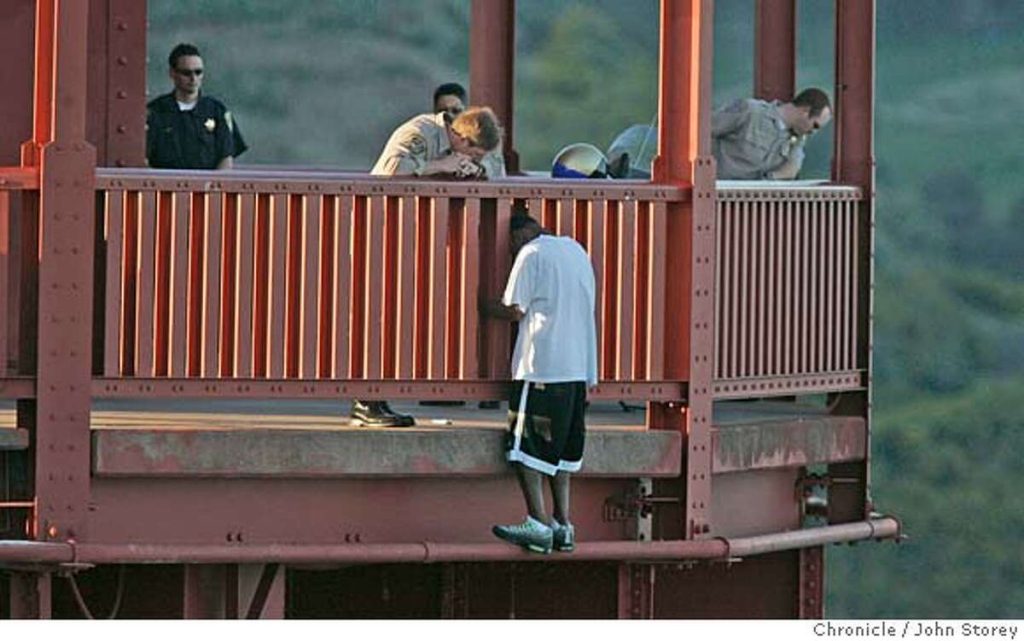
“There was a millisecond of free fall. In that instant, I thought, what have I just done? I don’t want to die. God, please save me.”
– Kevin Hines, The Bridge, (2006)
Today, Hines is an outspoken activist, helping others turn away from their own Golden Gate Bridges. I believe his radical pivot in life is due to a small detail in his final thoughts as he plummeted, his body suspended halfway between heaven and hell.
There are countless stories of those who decided to turn back. Sometimes it’s not even an emotional breakthrough — it’s the rekindling of a weak ember in their chest, a fire that hasn’t been there since they were children.
On Stepping Aside
Accomplished suicides are immensely sad. To attempt ones own life is to submit to the unnatural sorrow that is our day-to-day. And due to the very nature with which many take their lives, there is almost never time for a second thought. No pained tears or heart-clenching memories can put a bullet back in the muzzle of a gun once the trigger is pulled against the temple. The chemicals packed in the cartridge that loosed the bullet and the physics that sent the firing pin into the primer don’t care if you realize your mistake or not.
There are less survivors than victims because the laws of of the universe are cold and impersonal, in the same way there is no driver behind the wheel of the car heading towards me. There’s no emotion and no fear; no angry horns blaring or brakes squealing. All that remains is a physics equation, “force equals mass times acceleration.”
Dodging a Train
Skepticism has often been my go-to method for probing the world. An innate part of me has always questioned religion, unfounded claims, the words of others, and structures of authority. I owe my life to that sense of doubt.
On my day of departure, what some of us refer to us, “catching the bus,” my place was spotless. I had a printed note and instructions for my family, which sat on my desk. There was also a more personal letter to my loved ones on the pillow of my bed, because I did not know that suicide invites the destruction of one’s own memory.
My head swam left and right, and my vision blurred from the alcohol, not tears. I was halfway there already — the pills would do the rest. I squinted into the bottom of the small orange bottle of barbiturates on my nightstand, and I sat on my edge of my bed. Strangely, I don’t remember much anxiety or a heart-pounding sadness during the act. I remember the sudden calmness of mind.
I was too far gone to realize I was on the proverbial road, a deer wide-eyed in the headlights. All I had to do was “hold still” and let the imperial forces of mental illness and chemistry ease me down.
A Rush of Blood to The Head
When the human body faces mortal peril, or, when the need is dire, something strange happens — in its final throes, the body makes a final effort to preserve itself:
- The body and skin weep with sweat like a silent scream
- The pupils dilate, and pain receptors in the nervous system — already too drunk to feel anything — switch off
- Veins flush with blood and epinephrine, endowing the body and mind with strength they haven’t wielded in years
- The heart — a muscle the size of the victim’s fist, no longer stumbles in the chest, but marches, as if marching to war
Up until that point I always believed that the mind can accept its death, but the body could not. I thought I convinced myself, mind body and spirit, that it was my time. Thankfully, I was wrong.

Much like the body’s endocrine system, our brains have a built-in safety mechanism.
Imagine a guard lifting the veil over a condemned man’s eyes as they’re lead to the gallows. All at once the victim can see their means of death; can picture themselves dangling limp from the end of the noose. The dream of mental illness comes to a brief intermission, and all you have left to do is stay for the final act, a curtain call that no-one wants to happen, that no one’s going to clap for at all. Or… or you can leave.
I don’t care what it’s called any more, because I know what I saw in the bottom of the bottle of those pills, what stepped out of the bright headlights barrelling towards me.
I was seven-years-old. I was not smiling at my older self. Even at that age I was afraid to smile. Younger me stood in place of myself on the road, my slightness of frame enveloped in the white light of oblivion.
The child who was about to die wanted to be a writer when he grew up. He wanted a dog, and he couldn’t wait for the next Pikmin game. There was a light in his eyes as he glared back at me. Though small and shy, those eyes said that little kid on the road still believed he was going to become something.
I yelled across time and space the words that had become my prayer, “I’m sorry.”
I hadn’t just failed my friends and family by trying to kill myself at twenty-two. I failed this hopeful little kid; a kid I could barely recognize now, but knew he was me by his downy blond hair.
I watched the sky turn pink in this kid’s backyard; I walked the rail fences between his house and the house of his best friend, who’s still my best friend today. One day, I saw that kid touch pencil to notebook paper and find a moment of clarity that has no suicide attached.
In that sliver of time, something switched in my being. Like a fog lifting against the morning sun, the kindling I’d built up inside of myself from years of grappling with pain, finally caught the sparks I’d so helplessly showered it with. Though a bit of an oversimplification of the event and reasoning, I knew for certain I wanted to be the hero my younger self believed in. And I realized… I still had a chance.
The human condition is one of mucous and tears, a balancing act between alchemy and empiricism. But cars? Cars don’t weep when they strike the deer in the headlights. They blow through whatever, or whoever, is on the road.
I wasn’t about to let a kid like me get hit by that car.
Imagining Oneself Happy
One of the great agonies of choosing life is the aftermath of doing so. After I poured the remainder of my liquor down the sink, and after I ditched the bottle of Alprazolam, I heard that same old voice soon after, cruel and unusual, say, “this will happen again.”
That voice is certainly correct.
The Long, Gray, Struggle…
In the original Greek mythology, the mortal Sisyphus betrays Zeus. Zeus scorns Sisyphus, and dooms him to roll a massive boulder uphill, day in, day out, for all of eternity. No matter how close Sisyphus gets to reaching the top of the hill, the boulder rolls back to the bottom, forcing him to start again.
When I made the distinct choice to honor my younger self, to believe in the idea of hope, and ultimately choose to fight again, my reward was that of our hero Sisyphus: exhausted from the fight, on my back, at the bottom of the hill.
Camus’ writing has always tried to confront a prevailing sense of hopelessness that so many people feel before they leave this Earth. Camus himself dwelt at such depths, even before the second world war gave him a name for his boulder. For all the beauty in his prose, one can always find an existential struggle screaming at us from the subtext.
It’s no surprise that in Camus’ take on the myth, Sisyphus struggles against the boulder for endless centuries, left bitter and whittled down by task. Sisyphus’ effort shapes his body; rivets him with pain. His face hollows, his shoulder braces against the clay-covered mass in order to heave it up the hill. His limbs cord with muscle, and with time his efforts are less. He is no closer to happiness, because every day, his boulder will roll down the hill again.
To those of you who understand the gravity which mental illness imposes on us every moment of every day, you may see a splinter of yourself gritting your teeth in a strain against pointlessness. You understand the trembling arms and legs of Sisyphus; you echo his curses towards the gods.
Stopping oneself from dying does not clear the gray skies overhead, and it does not often heal us either. The reality is that all we have left afterwards is a boulder to push up a hill.
…In Pursuit of Joy
Camus’ most formative, urgent years lived and died like a beautiful flower whose owner had only fed it shade. The turmoil brought about by war and a life on the ropes forced him to confront, often, “the fundamental question of philosophy.”
Some of us are damned to roll a boulder up a hill for the sin of our birth. And if you capture Sisyphus’ task in that dour framing, well, he is more misery than he is man. His punishment truly is just that — punishment.
Camus posits (across a myriad of his selected works) that human existence is fruitless, painful, and absurd; that our daily skepticism against hope is our boulder to roll up the hill. When we yearn for the unattainable happiness prescribed by others and the world at large, we only invite pain into our lives.
“When the images of Earth cling too tightly to memory, when the call of happiness becomes too insistent, it happens that melancholy rises in man’s heart: this is the rock’s victory, this is the rock itself. The boundless grief is too heavy to bear. These are our nights of Gethsemane.” – Albert Camus, The Myth of Sisyphus, page ninety-seven
Many of us mistakenly believe the “call of happiness” is a total defeat of their mental illness, or like Sisyphus, finally rolling the boulder up the hill. I have come to believe is that there will never exist a “new me” without severe mental illness, just like Sisyphus will never roll his boulder to the top of the hill.
To survive, I released my white-knuckled grip on the controls of my own happiness. I accepted the bitter tonic of the hand I had been dealt by life, and that in all likelihood, I would not live the kind of life I thought I wanted.
Letting go of the struggle released the weight I did not know I carried. Therapy, pills, loved ones and friends… I can have all of these things — even with no end to the mental illness in sight — and still believe myself happy, still work towards those solemn joys that, in effect, make life “worth living.” As Camus puts it, I must become like the blind man who desires to see the day.
“Thus, convinced of the wholly human origin of all that is human, a blind man eager to see who knows that the night has no end, he is still on the go. The rock is still rolling.” – Albert Camus, The Myth of Sisyphus, page ninety-eight
What kept me alive wasn’t some noble idea that I could make younger me proud to grow up, or that I could live in harmony with my symptoms, at least not entirely.
It was a juvenile thought, but its resonance still echoes in my skull, like the inaudible hum of cosmic background radiation. It’s that last sentence in The Myth of Sisyphus, heavy on the tongues of the mentally ill; the one like a lantern lit for those still lost in the dead of the night, that gave me lift.
“The struggle itself toward the heights is enough to fill a mans heart. One must imagine Sisyphus happy.”
– Albert Camus, The Myth of Sisyphus, page ninety-eight
The mind of the mentally ill is an arena of Sisyphean struggle — a question of one’s desire to continue living in a world that doesn’t care about us enough to stop a boulder from rolling backwards. Maybe that’s why we gravitate towards existential thinking, like the sick looking for their medicine.
The idea that Sisyphus could be happy in his task, simply because he has the agency to choose happiness — or at least work towards what he deems “happiness” — was Earth shattering to me at the time, and even today.
If you’re wondering, I still have a lot of bad days and symptoms. But I am alive. And there is still a me who exists, who is seven-year-old. He’s smiling, because when he grows up, he’s the man he wants to be.
You and I in Unison
If you also struggle with a severe mental health condition, you might find that yourself and those like you are bound not just by your symptoms, but shared experiences and a common language. We are a people as close to life as we are death, and to dance upon that line is to inherit the memories and the lessons of those who came before you in this search for meaning.
If you are worried you may hurt yourself or others, please get help. Call 998, or talk to someone. There is no shame in hospitalization, medication, or therapy. Many of us have been where you may be now, and we have survived because we sought help.
Suicide rips a hole in the earth that your casket will never fill. No matter your “noble intentions” by your death, your memory will always carry unbelievable weight to those who loved you. Some of them will hate you. Others will love you, still, but carry with them anger and confusion forever.
Early in 2026, my best friend and mentor took his own life. The difficulty in talking about his death comes from the anger suicide bestows on its survivors. I loved him like a brother, but part of me hates him for leaving, for breaking all ties and promises we made to each other; for making me write his eulogy.
And I hate the fact that I hate him, because despite his absence I miss him so much he haunts me.
There are certain things I cannot do, see, or hear, because the ghost of my friend does not permit me to. The poem Reverse Suicide by Matt Rasmussen is completely unreadable to me. The song Flag Pole Sitta by Harvey Danger — a song I used to love — now forces choking sobs from my chest. I don’t take my coffee black any more because he taught me how to appreciate life’s bitterness in the same palate I enjoy coffee.
I still text his disconnected number.
Still, if there is one lesson my friend has yet to teach me, then it is internalizing what Camus wrote about throughout his life: how to claim happiness in the face of the absurd. Because that’s what suicide is, a reaction to the absurd.
Alfred Lord Tennyson, a poet that my friend and I bonded over, wrote one particular poem whose closing stanza we’d often quote. Ulysses is an epic poem about striving for greatness, a poem of the pain and weariness of age, and, we both believed — at least I still do — of hope.
The last stanza of Ulysses is special to me, as it was special to my friend. No matter how horrible our lives became, how cruel our mind was to us, together we’d look back on those beautiful, prophetic lines, and draw from the clear waters of light and love a medicine that would rinse our veins clean, empty us of hope, so that we could find, at last, one equal temper of heroic hearts in each other.
I leave it for you.
Tho' much is taken, much abides; and tho'
We are not now that strength which in old days
Moved earth and heaven, that which we are, we are;
One equal temper of heroic hearts,
Made weak by time and fate, but strong in will
To strive, to seek, to find, and not to yield.

- Ulysses, by Alfred Lord Tennyson
To my friend Zach; to all those giving up; to all those giving in: until I die I will sing our names in unison.